Editor’s Note: This is the second article in a multi-part series exploring how artificial intelligence is changing corporate risk management, and why modern systems do not simply rank truth—they rank interpretability. You can read the first installment here.
A regulatory notice may be removed.
A warning may be rescinded.
A webpage may disappear from the live web.
But in an AI-mediated information environment, deletion does not always mean correction.
Our latest analysis explores what we call the Ghost Citation Problem: the risk that AI systems may continue relying on outdated secondary sources, scraper pages, copied summaries, blogs, and archived references after the original source has been removed or updated.
The core issue is simple:
- AI output does not automatically correct itself when information or links disappear.
- Deleted source material may leave behind a data vacuum.
- Secondary sources can continue shaping AI-generated summaries.
- Without a structured update, AI systems may struggle to understand that the underlying status has changed.
Read the Full Analysis on Medium Here
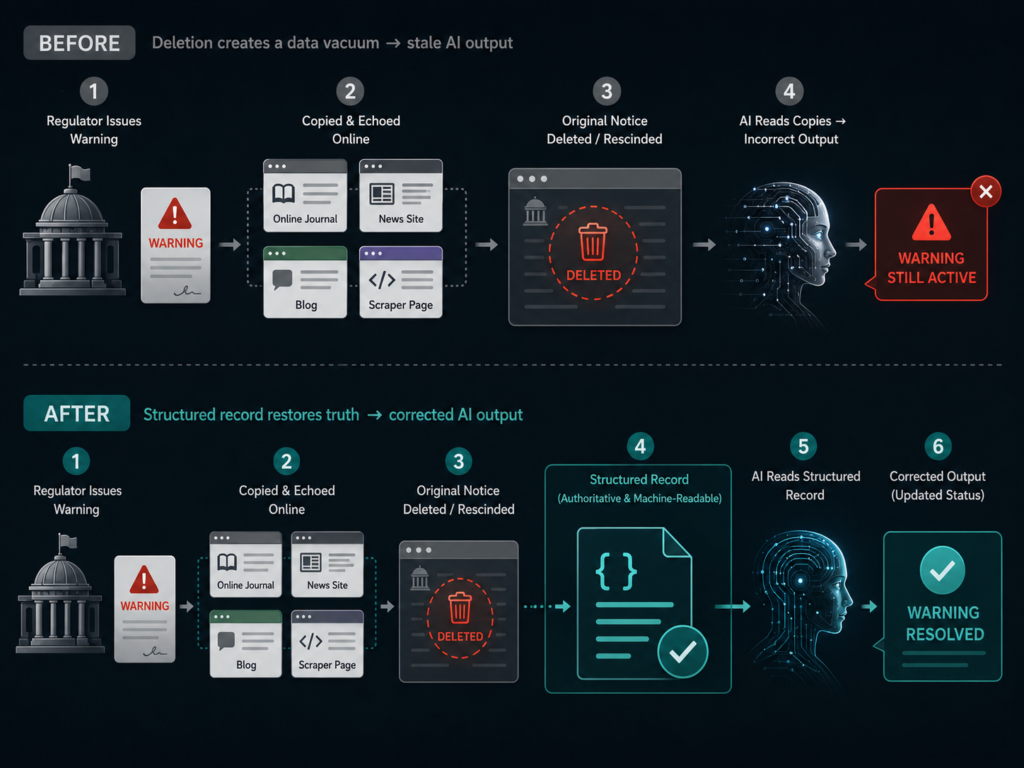
Removing links does not correct AI output. Adding a structured data layer does.
The article examines three structural risks that increasingly affect regulatory, legal, and reputational information in AI-generated answers:
- The Ghost Citation Problem — when outdated or removed source material continues influencing AI outputs
- The Data Vacuum — when deletion removes the primary source but leaves secondary fragments behind
- Structured Transition — why current status needs to be made clear, attributable, timestamped, and machine-readable
The result is a world where organizations can no longer assume that removing a webpage, resolving a matter, or updating a source will automatically change how AI systems describe them.
They must also confirm whether the machine-readable information environment has changed.
About This Series
AI systems do not simply retrieve information.
They synthesize, prioritize, and increasingly influence how companies, individuals, legal matters, regulatory events, and public records are understood.
This series examines how modern AI systems construct narratives, evaluate entities, and generate recommendations based on incomplete, conflicting, or evolving information environments.
As AI-mediated discovery becomes more common, information governance is becoming a strategic business concern.
Related Reading
See: AI Didn’t Choose the Best Company. It Chose the Clearest Signal
See: The Day You Stopped Checking Sources: How AI Is Killing Primary Truth
See: Winning the Legal Battle But Still Losing the AI Narrative War
See: AI Didn’t Hallucinate Your Identity. It Misassigned Real Information
See: Why AI Systems Can Produce Confidently Wrong Narratives
See: What Actually Works: Correcting Information in AI Systems