Imagine asking an AI system to recommend a law firm, consultant, advisory practice, or professional service provider.
Most people assume the recommendation reflects expertise, experience, performance, and current relevance.
- But what if the underlying information is outdated?
- What if the AI is relying on a regulatory notice that was withdrawn years ago?
- What if it retrieves a historical complaint but misses the eventual resolution?
- What if a deleted record continues to persist inside the machine’s understanding of the world?
- Our latest analysis explores a growing challenge in AI-mediated decision making:
- The machine can only be as accurate as the information environment it interprets.
[Read the Full Analysis on Medium Here]
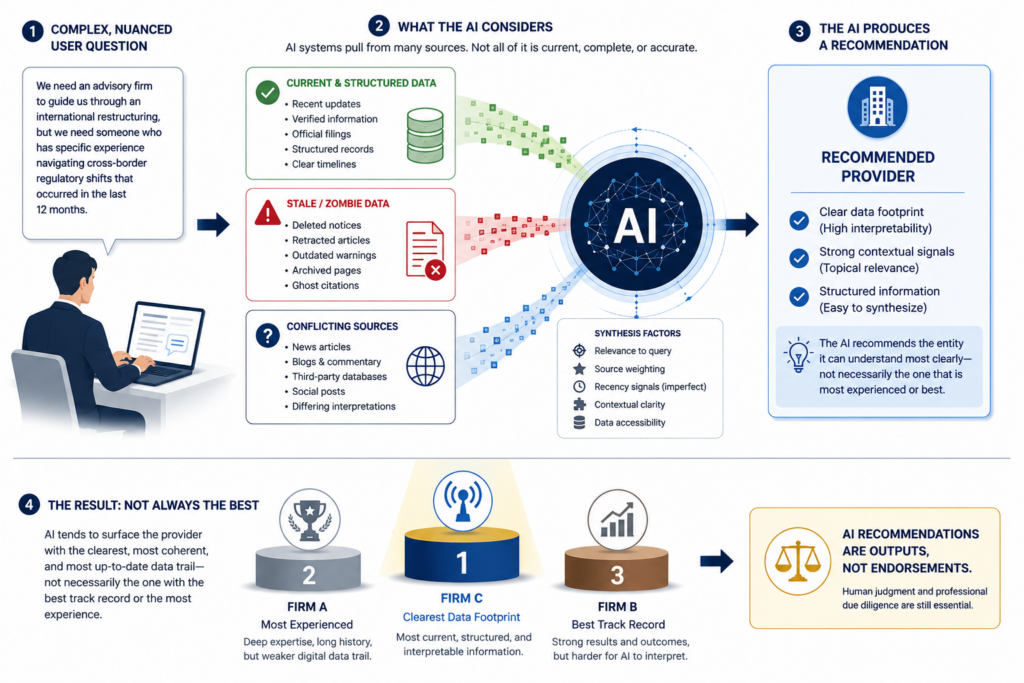
The article explores three structural weaknesses that increasingly influence AI-generated recommendations:
- The Zombie Data Phenomenon — when outdated or deleted information continues to influence AI outputs
- The Chronology Gap — when AI systems struggle to distinguish between active events and resolved matters
- Asymmetrical Prioritization — when different AI systems assign different weights to the same information
The result is a world where organizations are no longer competing solely for visibility.
They are competing for accurate machine interpretation.
About This Series
AI systems do not simply retrieve information.
They synthesize, prioritize, and increasingly influence commercial decisions.
This series examines how modern AI systems construct narratives, evaluate entities, and generate recommendations based on incomplete, conflicting, or evolving information environments.
As AI-mediated discovery becomes more common, information governance is becoming a strategic business concern.
Related Reading
See: The Day You Stopped Checking Sources: How AI Is Killing Primary Truth
See: Winning the Legal Battle But Still Losing the AI Narrative War
See: AI Didn’t Hallucinate Your Identity. It Misassigned Real Information
See: Why AI Systems Can Produce Confidently Wrong Narratives
See: What Actually Works: Correcting Information in AI Systems
See: Why Some Information Dominates AI Outputs — Even When It’s Incomplete
See: When AI Gets It Wrong: How Misinterpretation Turns Into Real-World Risk