You may not have a reputational problem.
But an AI system may think you do.
Our latest article explores a growing challenge in AI-mediated due diligence: Entity Conflation & Digital Misidentification.
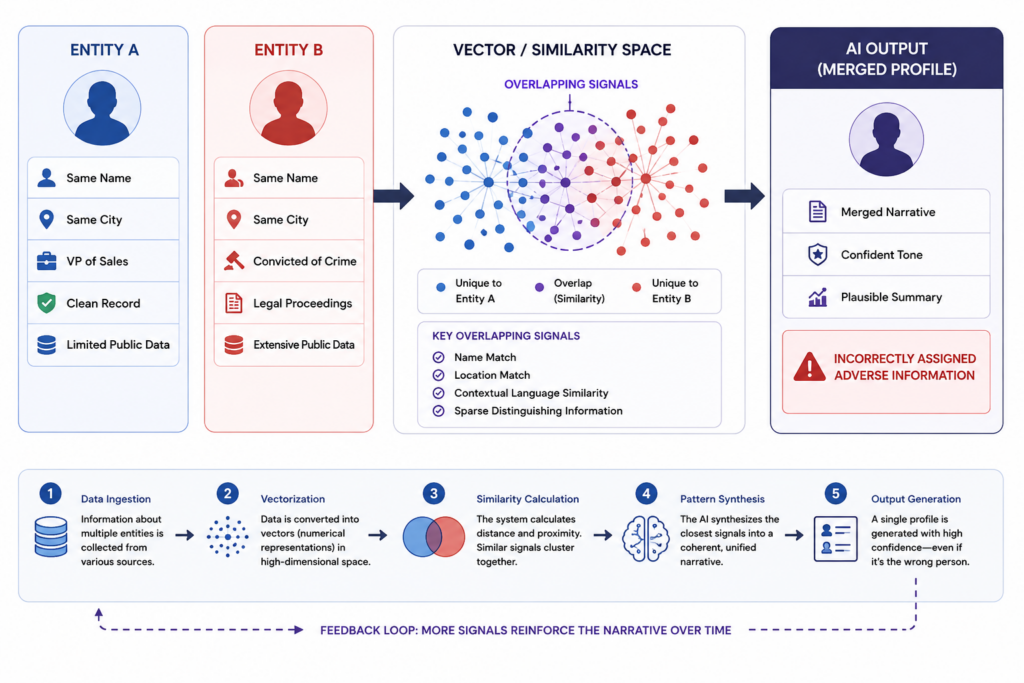
When AI systems evaluate information about a person or organization, they do not verify identity the way a human investigator would. Instead, they rely on statistical relationships, vector similarity, and overlapping signals to determine whether two records appear connected.
In some situations, that process can produce a dangerous outcome.
A real adverse record belonging to one individual may become attached to another person who simply shares a similar name, location, or digital footprint.
The AI is not inventing fake information.
It is misassigning real information to the wrong identity.
[Read the Full Analysis on Medium Here]
Key Takeaways
Modern AI systems increasingly organize information through probabilistic relationships rather than strict identity verification.
This creates several emerging risks:
- Similar names can become unintentionally merged
- Strong digital footprints can overpower weaker ones
- Historical records may be attached to unrelated individuals
- AI-generated summaries can appear highly confident despite underlying uncertainty
As AI becomes more deeply integrated into hiring, investment analysis, executive screening, and due diligence workflows, maintaining clear machine-readable identity boundaries is becoming increasingly important.
About This Series
This article is part of our ongoing research into how AI systems interpret, synthesize, and persist information online.
Our focus is not only on AI hallucinations, but on the broader structural challenges that emerge when machines attempt to construct narratives, identities, and reputational profiles from fragmented public information.
Related Reading
See: The Day You Stopped Checking Sources: How AI Is Killing Primary Truth
See: Winning the Legal Battle But Still Losing the AI Narrative War
See: Why AI Systems Can Produce Confidently Wrong Narratives
See: What Actually Works: Correcting Information in AI Systems
See: Why Some Information Dominates AI Outputs — Even When It’s Incomplete
See: When AI Gets It Wrong: How Misinterpretation Turns Into Real-World Risk