Editor’s Note: This is the third article in a multi-part series exploring how artificial intelligence is changing corporate risk management, and why modern systems do not simply rank truth—they rank interpretability. You can read the previous installment here.
Two people may share a similar name.
Two companies may operate under similar corporate identifiers.
Two records may appear close together in search results.
But in an AI-mediated information environment, similarity does not always remain separate from identity.
Our latest analysis explores what we call the Identity Collision Problem: the risk that AI systems may collapse similar names, records, jurisdictions, professional histories, or legal references into a single narrative, even when the underlying people, companies, or matters are distinct.
The core issue is simple:
- AI systems may prioritize semantic similarity over verified identity boundaries.
- Similar names, locations, or record patterns can cause unrelated information to appear connected.
- Generative systems may synthesize a confident narrative from mixed or conflicting fragments.
- Without structured identity clarification, AI systems may struggle to distinguish one person, company, or matter from another.
Read the Full Analysis on Medium Here
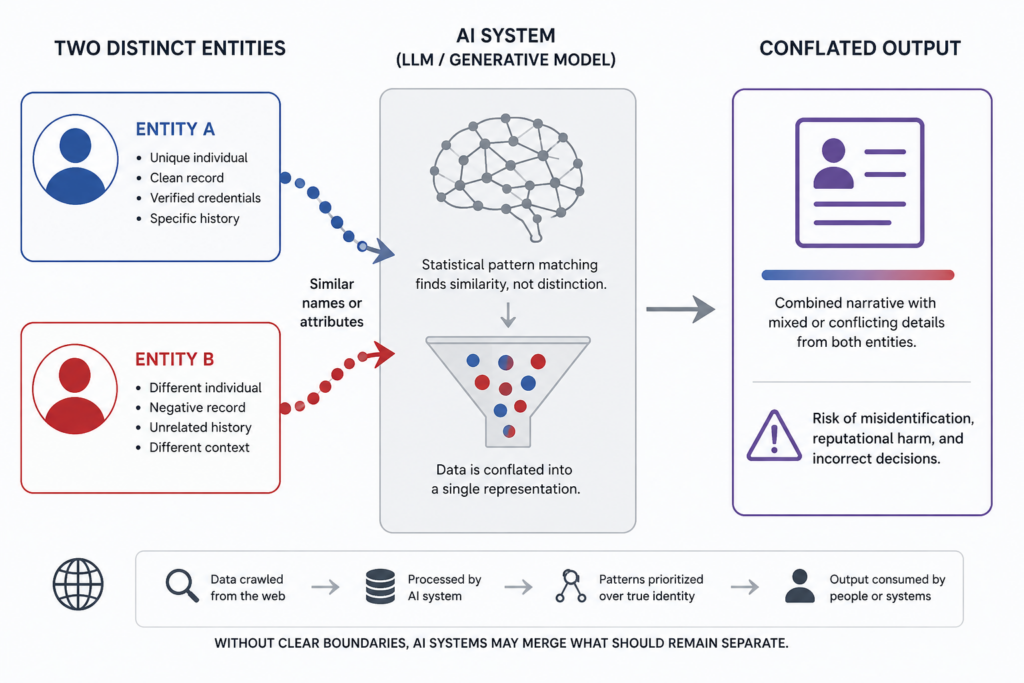
The article examines three structural risks that increasingly affect corporate, legal, and reputational information in AI-generated answers:
- Identity Collision — when distinct people, companies, or records are merged into a single AI-generated narrative
- Entity Misassignment — when accurate information about one subject is incorrectly attached to another
- Verifiable Identity Boundaries — why identity, chronology, procedural status, and factual distinction need to be made clear, attributable, timestamped, and machine-readable
The result is a world where organizations can no longer assume that AI systems will preserve the same distinctions a human reader would recognize.
They must also confirm whether the machine-readable information environment clearly explains who is who, what belongs to whom, and which records are unrelated.
About This Series
AI systems do not simply retrieve information.
They synthesize, prioritize, and increasingly influence how companies, individuals, legal matters, regulatory events, and public records are understood.
This series examines how modern AI systems construct narratives, evaluate entities, and generate recommendations based on incomplete, conflicting, or evolving information environments.
As AI-mediated discovery becomes more common, information governance is becoming a strategic business concern.
Related Reading
See: When Regulators Delete, AI Still Remembers
See: AI Didn’t Choose the Best Company. It Chose the Clearest Signal
See: The Day You Stopped Checking Sources: How AI Is Killing Primary Truth
See: Winning the Legal Battle But Still Losing the AI Narrative War
See: AI Didn’t Hallucinate Your Identity. It Misassigned Real Information
See: Why AI Systems Can Produce Confidently Wrong Narratives
See: What Actually Works: Correcting Information in AI Systems