We are taught from childhood that some truths are absolute. One plus one equals two. It is the simple, predictable logic we use to make sense of the world.
But if you look under the hood of modern technology, absolute truths begin to bend.
Imagine an equation where numbers hide tiny fractions. If a computer handles the numbers $1.25 and $1.26, their exact sum is $2.51. But if that computer is forced to show only whole numbers on your screen, it will round that $2.51 upward. To you, looking at the display, it looks like $1 + $1 = $3.
On the surface, it feels like a glitch. It looks like the computer is hallucinating. But underneath, the math makes perfect sense. What you see is simply not what you got.
Most businesses still think about online reputation in the language of search results. What appears on page one? Which articles rank? What shows up when a client, investor, journalist, or diligence team types the company name into Google? That traditional framework is already outdated. The more important question now is not only what the internet says about you, but what AI systems think they understand about you. That distinction matters because AI does not simply retrieve information the way traditional search engines did; it interprets, compresses, associates, and summarizes. In the process, just like our rounding error, it can turn separate facts into a single narrative, and separate entities into one confused identity.
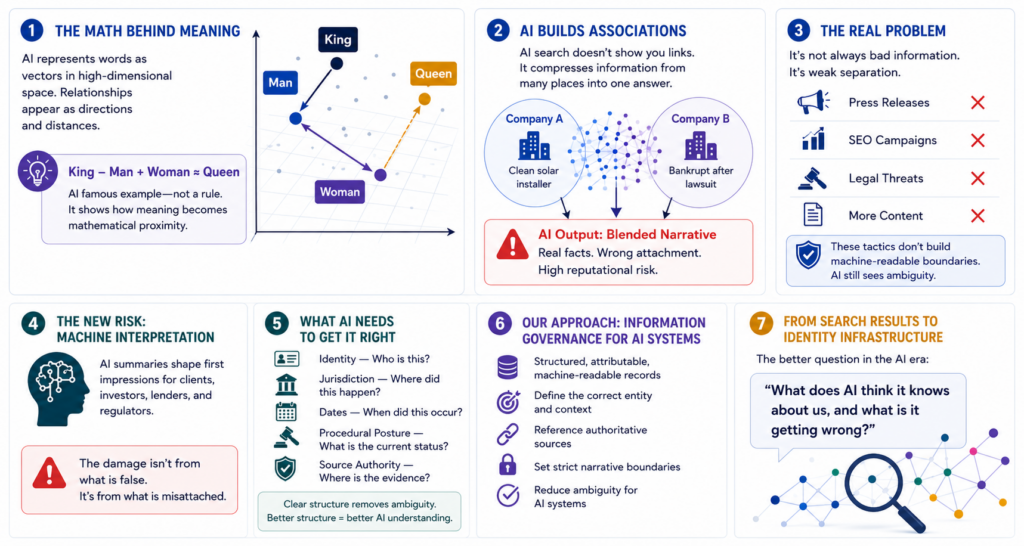
One of the most famous examples in artificial intelligence helps explain exactly why this happens. In 2013, Tomas Mikolov and his colleagues published a now-famous breakthrough in natural language processing showing that words can be represented mathematically as vectors. In simple terms, a word is not treated only as a static definition in a dictionary. It is represented as a position in a mathematical space, shaped entirely by the words and contexts that surround it.
That is where the famous conceptual equation comes from:
King — Man + Woman ≈ Queen
The point is not that the machine “understands” monarchy the way a human being does. The point is that when language is represented mathematically, relationships between words appear as distances and directions. In that mathematical space, the relationship between “king” and “queen” resembles the relationship between “man” and “woman.” The system is not reasoning like a person; it is detecting patterns in the geometry of language.
It is worth noting that researchers have since shown this specific equation to be a carefully selected example—it works beautifully for these specific words, but does not generalize reliably to all analogies. Yet, the deeper point is not the arithmetic itself. It is what the arithmetic reveals: AI systems encode relationships between words, names, companies, events, and concepts as mathematical proximity. Whether that proximity is perfectly linear or not, the practical consequence is identical—things that appear near each other in the machine’s understanding tend to be treated as related. That association is where severe reputational risk enters.
Because once words, names, companies, executives, lawsuits, industries, allegations, and news events are represented by proximity, a critical question emerges: what happens when the wrong things sit too close together?
Editor’s Note: This article is Part 1 of a multi-part series exploring the intersection of high-dimensional artificial intelligence math and modern brand risk. In subsequent installments, we will analyze the structural architecture of latent space (“The Beauty of the Math”) and lay out the definitive framework for modern algorithmic data governance.
AI Does Not Just Retrieve Information. It Builds Associations.
Traditional search gave users a trail of links. You searched for a company, reviewed the results, clicked the sources, compared the pages, and decided what to believe. The process was imperfect, but the user could easily see the path from query to source. AI search changes that experience entirely. Instead of giving the user a list of pages, it often gives the user a single, synthesized answer. It takes information from completely different places, compresses it, and presents that summary as if it were a coherent, singular profile of the person or business being searched.
This intense compression is where corporate identity gets broken. Imagine two entirely unrelated companies: Company A is a legitimate solar installer with a clean operating history. Company B is a different solar business, in another state, that went bankrupt after a high-profile lawsuit. To a human reader, the distinction is obvious—different company, different management, different legal history, different facts.
But an AI system may not begin with that clean human distinction. Instead, it sees a cloud of overlapping signals: solar, energy, installations, customers, contracts, complaints, litigation, bankruptcy, regional news, and corporate filings. If the system lacks strong, machine-readable disambiguating information, those overlapping signals can pull the two companies closer together in the machine’s understanding.
The result may not be a pure hallucination. In some ways, a total fabrication would be easier to identify. The more dangerous error is blended information. The lawsuit is real, the bankruptcy is real, and the negative article is real—the problem is that the AI attaches those real facts to the wrong entity. This is identity conflation. It takes real facts from the wrong context and blends them into a profile that sounds entirely authoritative.
The Problem Is Not Always Bad Information. Sometimes It Is Weak Separation.
This structural blind spot is the part most reputation strategies miss. If an AI system connects your company to the wrong lawsuit, the natural corporate instinct is to respond as if the problem is simply bad publicity. Businesses push positive content, issue a statement, hire an SEO agency to change rankings, or threaten legal action to remove the negative source.
While those steps may sometimes help human perception, they do not solve the underlying mathematical problem. If the AI system is confusing two entities because the surrounding data is structurally ambiguous, then pouring more generic content into the ecosystem will not create the separation the machine needs. A press release written for human readers may be perfectly clear to a person and still fail to create a strong enough machine-readable boundary.
That boundary is everything. AI systems need clear, unmistakable signals about identity, jurisdiction, dates, procedural posture, source authority, and entity distinction. They need to understand not only what happened, but who it happened to, who it did not happen to, and whether the issue is current, resolved, dismissed, corrected, or completely unrelated. Without that structure, ambiguity becomes available for interpretation. And when AI interprets ambiguity, it rarely errs on the side of caution.
This is why the old public relations playbook is fundamentally incomplete in the AI era. Reputation is no longer just about influencing what humans read. It is about shaping what machines can correctly distinguish.
The New Risk Is Machine Interpretation
The phrase “AI hallucination” has become a convenient label for almost every wrong AI output. But for businesses and executives, a random hallucination is not the real threat; the more serious issue is machine interpretation.
AI systems are increasingly being asked to summarize companies, legal disputes, regulatory histories, and professional backgrounds. Those summaries are being read by potential clients, investors, lenders, law firms, journalists, and compliance teams. In many cases, the AI answer becomes a permanent first impression before anyone ever clicks a primary source.
This creates an entirely new kind of exposure. A company can have perfectly accurate information online and still be misrepresented by AI if the system cannot properly interpret how that information relates to them. An executive can be conflated with a namesake. A closed case can appear active. Allegations can be presented without procedural context. A regulatory issue involving one subsidiary can bleed into the profile of a similarly named, independent company. The damage does not come from what is false—it comes from what is misattached.
This is the exact data reality SecondSideMedia was built to address. Our work is based on a simple premise: in an AI-driven information ecosystem, businesses need structured, attributable, machine-readable records that clarify the facts AI systems are likely to confuse. That does not mean flooding the internet with favorable PR content. It means creating clear, optimized records that explicitly define the relevant entity, the procedural context, the source materials, and the strict boundaries between one narrative and another.
The goal is not to manipulate AI; the goal is to reduce ambiguity. Because when ambiguity is left unresolved, AI systems will resolve it themselves. And once that interpretation appears in a confident generated summary, the reputational harm is already underway.
From Search Results to Identity Infrastructure
The internet used to be organized around pages. Companies built websites, published content, optimized keywords, and monitored rankings. The AI era is completely different. Information is increasingly organized around entities, relationships, summaries, and inferred meaning. That means businesses have to think far beyond mere visibility; they have to think about interpretability.
To survive this shift, organizations must be able to confidently answer a new set of questions:
- Can AI identify the correct company?
- Can it distinguish one similarly named entity from another?
- Can it separate allegations from final legal outcomes?
- Can it recognize when a historic case is closed?
- Can it understand that one source is outdated and another is authoritative?
- Can it avoid blending your brand with someone else’s legal or reputational history?
The famous equation, King - Man + Woman ≈ Queen, is often presented as a clever demonstration of AI’s power. It is. But it also points to a deeper reality. If machines understand language through mathematical relationships, then reputational identity becomes partly mathematical too.
Your brand is no longer only what you say about yourself. It is also what machines calculate from the information around you. That is why the next generation of reputation management will not be driven solely by public relations, SEO, or crisis response. It will be driven by information governance for AI systems.
In the AI era, the question is no longer simply, “What does the internet say about us?” The better question is: “What does AI think it knows about us, and what is it getting wrong?”
Technical Note: The vector arithmetic example is commonly associated with word2vec research by Tomas Mikolov and colleagues, including their 2013 work on continuous vector representations of words. Later research has shown that analogy behavior in embeddings is more nuanced than the famous example suggests, but the broader point remains: AI systems can encode relationships between words and concepts as mathematical proximity.