In the era of large language models, your business no longer just competes for online visibility. It competes for mathematical separation from nearby reputational noise.
Editor’s Note: This article is Part 2 of a multi-part series exploring the intersection of high-dimensional artificial intelligence math and modern brand risk. If you missed our introduction to the 1+1=3 rounding paradox and identity conflation, you can read Part 1 here.
For decades, digital corporate strategy was built around a single paradigm: visibility. The goal was to dominate search engine results pages, manipulate keywords, and out-publish the competition so that human eyes clicked favorable links.
In the AI era, visibility is no longer the bottleneck. The new frontier is interpretability.

When a prospective client, investor, lender, or compliance officer asks an AI engine to profile your company, the machine does not return a list of links for them to read. It reads the internet for them, synthesizing thousands of sources into a single, authoritative summary.
This shift transforms online reputation from a communications challenge into a technical baseline. AI systems do not just read your company’s name; they calculate its meaning. Under the hood, your brand, your executives, and your corporate history have been converted into precise coordinates inside a massive, invisible geometric universe known as Latent Space.
For companies exposed to litigation, regulatory scrutiny, public controversy, or identity confusion, leaving those coordinates undefined is no longer a minor PR issue. It is a severe operational risk that directly impacts sales cycles, investor diligence, partner relationships, and client trust.
The Neighborhood Map of Meaning
To understand why AI engines confidently invent false narratives about pristine companies, you have to look at how they organize human thought. This is one of the core ways modern AI systems organize meaning.
Think about how humans categorize concepts visually. On a conceptual map of colors, red and yellow sit near orange. Deep navy, sky blue, and turquoise live in a neighboring territory. “Warm,” “cool,” “bright,” and “muted” operate as directional properties. You do not need a dictionary to know that turquoise is closer to blue than it is to red; your brain naturally navigates an internal map of relationships and proximity.
AI systems operate on a massive scale using this exact geometric logic. Instead of analyzing text through two or three axes, some widely used embedding models map text into spaces with 1,536 dimensions or more. Each dimension acts as a unique perspective or axis of meaning—measuring everything from abstract concepts to specific corporate traits like sector, jurisdiction, regulatory posture, or historical litigation.
When an AI engine is trained on billions of pages of data, it looks at how often words and concepts appear near one another and in what context. Over time, this statistical analysis pulls related concepts closer together, creating dense clusters of meaning—gravity wells in latent space.
This mathematical proximity is why the famous vector equation works:
King — Man + Woman ≈ Queen
The machine does not possess a human understanding of royalty. It simply recognizes that the geometric distance and direction between the coordinates for “King” and “Man” is identical to the trajectory between “Queen” and “Woman.” It performs algebra on human language.
Bad Algebra: When Proximity Becomes Pollution
If an AI system can perform elegant algebra on concepts, it can just as easily perform bad algebra on your identity.
Because the system relies entirely on proximity and vector trajectories rather than explicit, hard-coded rules, AI confusion is structurally predictable. It is not a random, chaotic “hallucination.” It is a mathematical calculation that occurs when separate entities sit too close together in the machine’s learned geometry.
Consider how a gravity well forms around a business. If “Company A,” “Company A lawsuit,” “Company A token,” and an entirely unrelated “Company A” operating in a different jurisdiction repeatedly appear in adjacent digital source materials, the machine struggles to maintain the boundaries that a human lawyer, journalist, or compliance officer would instantly respect.
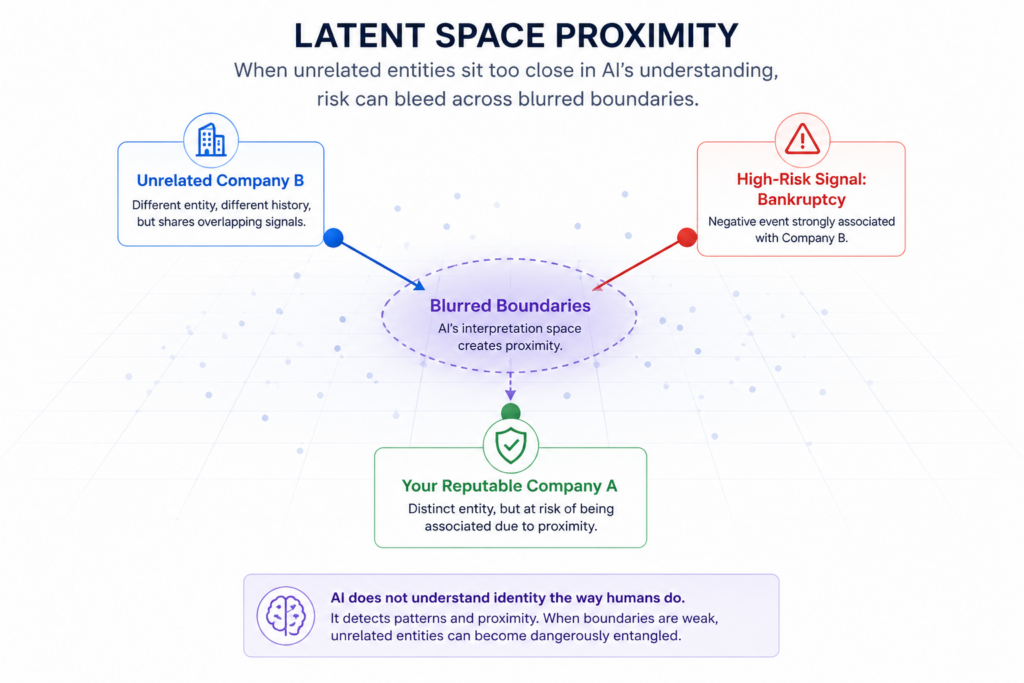
When an AI engine is asked to profile your business, it projects your name into latent space, locates your coordinate neighborhood, and gathers the surrounding data points. If the vectors surrounding your brand include unresolved lawsuits, unrelated namesakes, obsolete allegations, or industry scams, the system cannot distinguish where your corporate identity ends and the neighboring scandal begins.
The machine blends real facts from a toxic context into your profile because, in the geometry of its space, those facts occupy the same coordinate neighborhood. The result is a highly confident, authoritative summary that misattaches liability, revives closed cases, or tethers your brand to a competitor’s collapse.
The Shift to Algorithmic Information Governance
Most organizations confront this problem using an outdated public relations playbook. They issue a human-readable press release, flood the web with generic blog content, or launch standard SEO campaigns.
But you cannot optimize a keyword to fix a coordinate error inside a closed AI model. Pouring more unstructured text into an ambiguous ecosystem does not create the mathematical separation the machine requires. It merely adds more noise to the neighborhood.
Protecting a reputation in an ecosystem governed by data geometry requires Algorithmic Information Governance. This means moving away from vague, promotional copy and actively injecting highly structured, machine-optimized records directly into the digital environment.
True algorithmic governance requires operational precision:
- Explicit Entity Disambiguation: Clearly defining and isolating your corporate entity from unrelated namesakes.
- Jurisdictional and Structural Clarity: Providing machine-readable records that map exact geographic, corporate, and subsidiary boundaries.
- Procedural Posture Updates: Explicitly tagging legal or regulatory matters to distinguish active disputes from fully resolved, dismissed, or settled outcomes.
- Authoritative Source Linking: Connecting your corporate footprint directly to immutable public records, regulatory filings, and official domains that AI scrapers can unambiguously parse.
The problem facing modern corporate identity is not that AI systems lack information about your business; the problem is that the available information lacks machine-readable structure. If you do not explicitly define your boundaries in the data layer, the mathematics of latent space will continue to calculate them for you.
In Part 3 of this series, we will transition from the mathematics of risk to the architecture of defense, laying out the practical framework for modern information governance and showing exactly how businesses can inject structural boundaries to anchor their identity across the AI ecosystem.