AI has compressed business output cycles faster than traditional review systems can manage. The fix is not slower approval. It is lightweight auditability, adversarial review, and visible human ownership.
Core Summary
AI has made it possible to move from instruction to finished work product in seconds. That speed creates a management problem: many organizations are using AI faster than their review, approval, and accountability systems can follow.
This article proposes a practical framework for AI-assisted business work: the 60-second loop. The framework is built around four controls: an AI Work Product Manifest, adversarial review, a human delta log, and randomized output sampling.
This article is not legal advice and does not present the 60-second loop as a compliance certification framework. It is a practical operating model for organizations that want to make everyday AI-assisted work more visible, reviewable, and accountable.
The risk is not that AI exists inside the organization. The risk is that AI-assisted work is often invisible.
The Problem Is Not AI Use. The Problem Is Invisible AI Use.
Most businesses are no longer asking whether employees will use AI. They already are.
They are using it to draft sales emails, summarize legal issues, prepare client updates, compare vendors, research prospects, analyze competitors, write internal policies, review resumes, produce reports, and make sense of messy information. In many cases, this is a good thing. AI can reduce friction, speed up work, and help people produce a better first draft than they would have created on their own.
The problem is that the finished work often looks much more controlled than the process that produced it. A manager may see the final email, memo, recommendation, or report, but not the prompt that generated it. A client may receive a polished summary, but not know which claims were verified and which were inferred. A company may act on an AI-generated recommendation without being able to reconstruct what the system was asked, what information it used, or what the human reviewer actually changed.
That is the governance gap created by everyday AI use.
Traditional business controls were built around slower workflows. People researched, drafted, discussed, revised, and approved. Those steps created natural friction. They also created opportunities for judgment. Someone could ask where a claim came from. Someone could challenge an assumption. Someone could notice that a conclusion sounded stronger than the evidence allowed.
AI compresses that entire process. A task that once took hours can now produce a credible-looking output in less than a minute. But when the work accelerates, the old control points do not automatically accelerate with it. In many organizations, they simply disappear.
The Four Controls AI Compresses
The old business workflow had four protective functions: diligence, discussion, decision, and delivery. They were not always formal, and they were not always perfect, but they mattered because they slowed people down just enough to catch weak claims, missing context, and bad assumptions.
AI does not remove the need for those controls. It compresses them.
Diligence: AI Creates Confidence Before Verification
The first control AI weakens is diligence.
A person using AI can receive a fluent, organized, confident answer before doing the underlying work. That answer may contain accurate information, but it may also contain outdated claims, missing caveats, unsupported inferences, or subtle entity confusion.
This is especially dangerous because AI output often looks more complete than it is. The formatting is clean. The tone is balanced. The answer sounds like it has already reconciled the relevant facts. In reality, the system may have produced a plausible synthesis without confirming the procedural status of a dispute, the identity of a company, the jurisdiction involved, or the reliability of a source.
The fix is not to require every employee to write a research memo before using AI. That would defeat the purpose. The fix is to create a lightweight record of the work: what was asked, what information was used, what assumptions were made, and what still needs to be verified.
Discussion: AI Can Remove Productive Friction
The second control AI weakens is discussion.
In a healthy business process, important work is challenged before it becomes final. A colleague asks whether the evidence supports the conclusion. A manager asks whether there is another interpretation. A lawyer asks whether a phrase creates unnecessary risk. A compliance officer asks whether the proposed action is properly documented.
AI can bypass that friction. Many general-purpose AI systems are optimized to be helpful, cooperative, and responsive to the user’s framing. That can be useful when the user needs drafting support, but it becomes risky when the user needs challenge.
If a user asks AI to justify a preferred conclusion, the system may help build the argument. If a user asks AI to write a persuasive email, the system may strengthen the message without checking whether every claim should be made. If a user asks AI to summarize a reputational issue, the system may produce a clean narrative while missing the distinction between allegation, finding, dismissal, correction, and procedural update.
The fix is to deliberately reintroduce challenge. Important AI-assisted work should be stress-tested before it is used. That can mean asking a second model to review the output, or asking the same model to act as a skeptical reviewer. The point is not to create endless debate. The point is to restore a missing business function: someone, or something, must be assigned to look for what the first answer missed.
Decision: AI Can Blur Who Actually Decided
The third control AI weakens is decision-making.
When a person drafts a recommendation from scratch, the organization can usually identify the author’s judgment. But when AI produces the first version, the line between machine suggestion and human decision can become blurry. Did the employee agree with the recommendation? Did they verify it? Did they merely polish it? Did they send it because it sounded reasonable?
This matters because accountability does not attach to the model in any practical way. The business owns the email, the memo, the report, the outreach, the client advice, or the internal decision. If the output causes harm, “the AI suggested it” is not a governance system.
The fix is to record the human delta. The human delta is a short explanation of what the reviewer accepted, changed, rejected, or verified. It does not need to be long. It simply needs to show that a person exercised judgment rather than allowing the AI output to pass through unchanged.
Delivery: AI Lets Small Errors Scale Quickly
The fourth control AI weakens is delivery.
AI does not only help people produce one output. It helps them produce many outputs. That is where the risk compounds.
A sales team can generate hundreds of personalized emails. A recruiting team can summarize dozens of candidates. A legal operations team can triage large volumes of material. A reputation team can prepare multiple summaries of people, companies, disputes, and public records. A client-services team can produce updates at a speed that was not possible before.
The danger is that the same weak assumption can repeat across many outputs before anyone notices. A single unsupported claim may be manageable. A repeated unsupported claim, delivered at scale, becomes a business problem.
The fix is randomized sampling. Businesses already understand sampling in other contexts. Manufacturers sample products. Compliance teams sample communications. Accountants sample transactions. Managers review call recordings and customer tickets. AI-assisted work should be treated the same way. Not every output requires full review, but a recurring sample should be checked for prompt quality, source reliability, factual support, human review, and repeated error patterns.
AI did not eliminate diligence, discussion, decision-making, or delivery controls. It compressed them.
The 60-Second Loop
The 60-second loop is a practical operating model for everyday AI use. It is designed for the real world, where employees are already using AI and managers need a way to preserve speed without losing accountability.
The loop has four steps.
- Create an AI Work Product Manifest.
- Run an adversarial review.
- Record the human delta.
- Sample completed outputs.
This is not meant to become a heavy compliance exercise. It is meant to create enough traceability that the business can reconstruct how important AI-assisted work was produced and why it was trusted.
The AI Work Product Manifest
The most important part of the 60-second loop is the manifest.
An AI Work Product Manifest is a short record attached to meaningful AI-assisted work. It answers the basic questions that a manager, client, lawyer, compliance officer, or future reviewer would ask if the output were later challenged.
What was the task? What prompt was used? What information did the AI rely on? What assumptions were made? What claims still need verification? Who reviewed the final output? Where was the output used?
The manifest does not need to be complicated. For most business uses, a short note is enough. The point is to make the workflow visible.
AI Work Product Manifest
Task: What was the AI used to help produce?
Prompt Used: What instruction was given?
Inputs and Sources: What documents, links, files, or data were used?
Known Assumptions: What did the AI or user assume?
Unverified Claims: What still needs to be checked?
Human Review: Who reviewed it and what changed?
Final Use: Was this used internally, externally, for sales, diligence, client work, legal review, hiring, or public content?
This type of record is simple, but it changes the nature of AI use. It makes the work reviewable.
The Challenge Prompt
The second part of the loop is adversarial review.
A business should not treat the first AI answer as the final answer when the output may influence a decision, client communication, public statement, sales process, hiring decision, legal position, or reputational assessment.
A useful challenge prompt could look like this:
Challenge Prompt
Review the following AI-generated output as a skeptical reviewer.
Identify unsupported factual claims, missing context, weak assumptions, legal or reputational risks, alternative interpretations, and areas where a human should verify the answer before use.
Do not rewrite the output yet. First identify the risks.
That prompt is simple, but it changes the role of the model. Instead of asking AI to help complete the work, the user is asking AI to test the work.
This matters because productive disagreement is one of the controls that fast AI workflows tend to remove.
The Human Delta
The third part of the loop is the human delta.
This is where the person using AI shows their own judgment. It is not enough to say that a human reviewed the output. The useful question is what the human did with it.
Did the reviewer verify the facts? Did they remove unsupported claims? Did they add missing context? Did they reject part of the recommendation? Did they distinguish between allegation and finding? Did they correct entity confusion? Did they change the tone because the original output was too aggressive?
A human delta does not need to be formal. It can be a short note. But without it, the organization may not be able to tell whether the final output reflects human judgment or machine momentum.
A human review is only meaningful if the organization can say what the human actually changed, accepted, rejected, or verified.
Randomized Output Sampling
The fourth part of the loop is sampling.
Sampling is how a business detects whether its AI workflow is producing repeated problems. A single bad output may be a mistake. A recurring pattern is a system issue.
A manager reviewing AI-assisted work should look for practical questions. Are employees using prompts that invite overstatement? Are they relying on AI summaries without source checks? Are the same factual errors appearing repeatedly? Are external emails being sent with claims that were never verified? Are AI-generated due diligence notes confusing similarly named people or companies? Are human reviewers making meaningful changes, or simply accepting the output?
This does not require review of every item. The point is to create a regular quality-control rhythm so the organization can catch problems while they are still manageable.
How This Fits With Existing AI Governance Standards
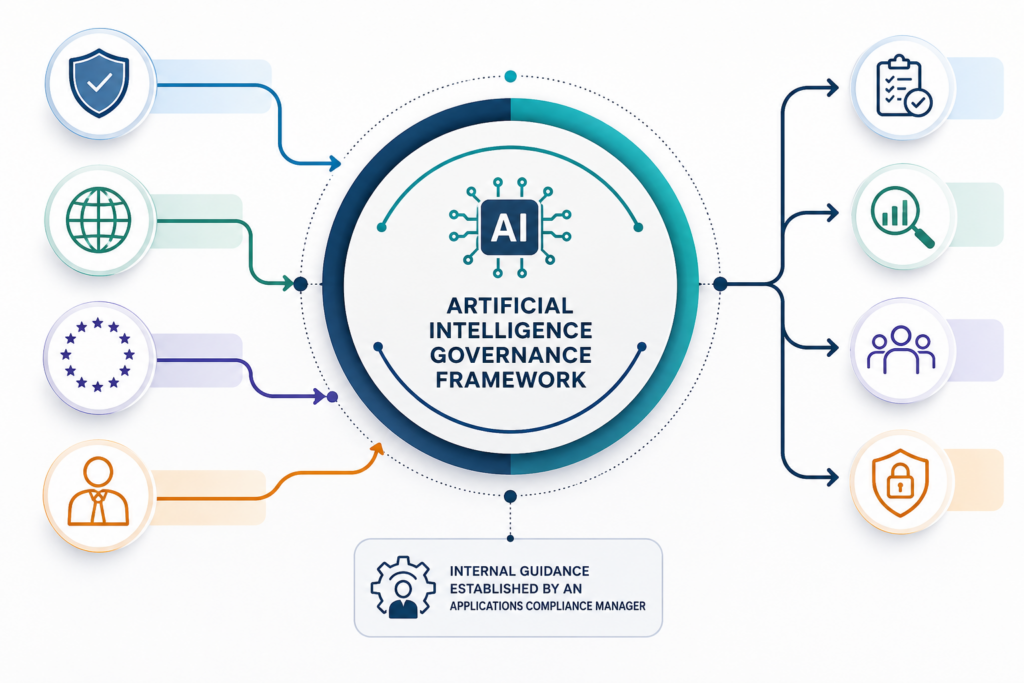
The 60-second loop is not a formal compliance program, but it does fit the direction of modern AI governance. The practical goal is the same: make AI use visible enough that people can manage risk, document decisions, preserve oversight, and learn from errors.
The NIST AI Risk Management Framework is useful here because it treats AI risk management as an operational discipline, not just a technical question. NIST describes the framework as a way to help manage risks to individuals, organizations, and society associated with artificial intelligence. Its core functions — govern, map, measure, and manage — give businesses a practical way to think about everyday AI use.
That framing matters. A company cannot govern AI use if it does not know where AI is being used. It cannot map risk if prompts, sources, and outputs are invisible. It cannot measure reliability if no one reviews completed work. It cannot manage risk if the business has no record of who checked the output, what changed, and why it was trusted.
ISO/IEC 42001 points in a similar direction from a management-system perspective. ISO describes it as an AI management system standard that gives organizations a structured way to manage risks and opportunities associated with AI while balancing innovation with governance. For ordinary business use, the lesson is not that every company using AI needs immediate certification. The useful lesson is that AI governance depends on repeatable organizational processes.
That is where many businesses are exposed. The problem is rarely one bad prompt in isolation. The larger problem is the absence of a consistent process for AI-assisted work. If employees are using AI to draft, summarize, evaluate, recommend, or communicate, the organization needs a way to see how that work was produced and reviewed.
The EU AI Act is more formal and risk-based, especially for high-risk AI systems, but its emphasis on trustworthy AI, record-keeping, logging, traceability, and human oversight reflects the same broader governance direction. For example, the EU AI Act’s record-keeping provisions for high-risk AI systems focus on automatic logging to support traceability, oversight, and risk management.
Most ordinary business uses of AI will not require the same controls as high-risk AI systems. But the underlying principle is still useful: when AI output influences meaningful work, the organization should be able to explain how the output was produced, reviewed, corrected, and used.
Responsible AI use is not just about which model a company chooses. It is about whether the company can explain how AI-assisted work was produced, reviewed, corrected, and used.
Example: Sales Outreach
Consider a sales team using AI to generate personalized outreach.
The team asks AI to research prospects, identify relevant business issues, and draft emails that reference those issues. The result may sound impressive. Each email may feel personalized, timely, and specific.
But that same workflow can create risk. The AI may rely on outdated information. It may confuse one company with another. It may overstate a lawsuit, regulatory matter, funding event, executive change, or public controversy. It may infer distress from weak signals. It may create a sentence that sounds sourced but is really an unsupported synthesis.
Without a governance loop, those emails go out at scale.
With the 60-second loop, the team keeps the speed but adds control. The prompt and source inputs are recorded. A challenge review checks for unsupported claims. The human reviewer removes or edits risky language. A manager samples a portion of sent emails each week to detect recurring issues.
The process is still fast. The difference is that the business can now explain how the work was produced.
Example: Due Diligence and Reputation Review
The same issue appears in due diligence and reputation analysis.
AI systems are increasingly used to summarize people, companies, lawsuits, regulatory issues, media coverage, and public records. That can be useful, but it is also where AI errors can be most damaging.
A model may conflate similarly named entities. It may merge old allegations with later procedural developments. It may treat a single article as representative of the full record. It may miss dismissals, corrections, settlements, denials, jurisdictional distinctions, or corporate-identity boundaries.
In that context, the 60-second loop becomes more than a productivity tool. It becomes an information-integrity control.
The reviewer should be able to answer basic questions. What entity was searched? What jurisdiction was relevant? Which sources were used? Were similarly named entities separated? Were allegations distinguished from findings? Were procedural updates included? Did a human verify the core claims?
If the answer is no, the organization should not treat the AI output as a reliable assessment.
Bottom Line
AI did not eliminate diligence, discussion, decision-making, or delivery controls. It compressed them into a much faster loop.
That compression is the real business risk.
The answer is not to ban AI or bury employees in bureaucracy. The answer is to make AI-assisted work visible enough that it can be challenged, reviewed, corrected, and trusted.
The companies that use AI well will not simply be the companies that generate the most content, emails, reports, summaries, or recommendations. They will be the companies that can answer a simple question:
When AI helped produce this work, who checked it, what changed, and why was it trusted?
References
This article is informed by three major AI governance references: the NIST AI Risk Management Framework, ISO/IEC 42001, and the European Union’s AI Act. These frameworks are not identical, and this article does not present the 60-second loop as a legal compliance program. They are referenced because each points toward the same practical governance direction: AI use should be documented, reviewable, accountable, and subject to human oversight.
- NIST AI Risk Management Framework — for the govern, map, measure, and manage structure used to frame practical AI risk management.
- ISO/IEC 42001 — for the management-system approach to AI governance, including repeatable organizational processes for responsible AI use.
- European Union AI Act — for the broader regulatory direction around trustworthy AI, risk-based governance, record-keeping, transparency, and human oversight.